Democratic Philosophy and the Politics of Knowledge by Richard T. Peterson
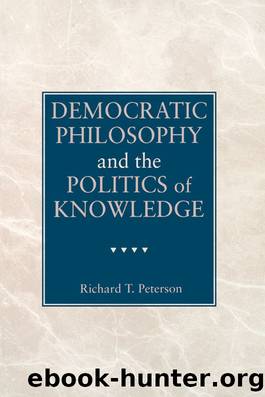
Author:Richard T. Peterson [Peterson, Richard T.]
Language: eng
Format: epub
Tags: Philosophy, History & Theory, Democracy, Political Ideologies, Political Science, Political
ISBN: 9780271025575
Google: 9ef6NjTlu1kC
Goodreads: 5434228
Publisher: Penn State Press
Published: 1996-04-15T00:00:00+00:00
Part Three
* * *
Postmodernism in Philosophy and Politics
With the idea of democratic philosophical criticism, or the critique of the division of labor, as presented in Part Two, I have spoken for a kind of reflection that contrasts with the prevailing hostility toward philosophical theory. Rather than the revival of traditional theory, however, this kind of reflection conjoins intellectual construction with political discussion. Nonetheless, it may appear to affirm a return to âgrand theoryâ and thus to run counter to the skepticism about theory that is found among critics of knowledge-power, the kind of skepticism that has some warrant in the evolution of modern knowledge-politics. Though now I have outlined an alternative to such skepticism, it may appear that I have simply adopted kinds of thinking rightly challenged by contemporary critics. In particular, I mean those kinds of criticism that often go under the label of postmodernism. I want to challenge this kind of criticism, though not so much to explore its many facets as to tie my claims about the critique of the division of labor more closely to contemporary debates and to develop further the idea of democratic philosophical criticism.
Part Three has two main aims. The first is to argue that at least one version of postmodernist philosophy has far more in common with the tradition it attacks than may first seem to be the case. From the standpoint of the critique of the division of labor, this kind of philosophy contributes to the evolution of modern knowledge-politics in a way that responds to the historical changes to which I have been referring and that figures within the emerging politics of the division of labor. I argue that the idea of postmodernism can just as well be applied to changes within contemporary politics in which postmodern philosophy represents one trend. Postmodernismâs relation to epistemology is not just a matter of the rejection of a certain kind of theory but has to do more generally with the epistemological features of liberal political culture.
After making a case for considering postmodern philosophy to be one feature of a postmodern politics, I pursue in the second part of the chapter the philosophical criticism of this politics. In this discussion I try to show that the critique of the division of labor is useful not only for thinking about the social role of philosophy but for thinking about the evolution of contemporary politics. My claim is that contemporary politics calls for philosophical criticism because the relation to power this politics organizes is one in which philosophical claims play an important interpretive role.
I am here concerned with reflecting on political evolution as it is tied up with intellectual mediation, particularly such evolution as addressed by and articulated in specifically philosophical reflection. I connect the rise of postmodern politics to the evolution of reflection on rationality in postmodernist philosophy. The point is not that the politics follows the philosophy but that the politics is partly organized by articulations that are developed directly or explicitly in the philosophy.
Download
This site does not store any files on its server. We only index and link to content provided by other sites. Please contact the content providers to delete copyright contents if any and email us, we'll remove relevant links or contents immediately.
| Anthropology | Archaeology |
| Philosophy | Politics & Government |
| Social Sciences | Sociology |
| Women's Studies |
The Secret History by Donna Tartt(19086)
The Social Justice Warrior Handbook by Lisa De Pasquale(12190)
Thirteen Reasons Why by Jay Asher(8909)
This Is How You Lose Her by Junot Diaz(6886)
Weapons of Math Destruction by Cathy O'Neil(6279)
Zero to One by Peter Thiel(5801)
Beartown by Fredrik Backman(5754)
The Myth of the Strong Leader by Archie Brown(5507)
The Fire Next Time by James Baldwin(5442)
How Democracies Die by Steven Levitsky & Daniel Ziblatt(5218)
Promise Me, Dad by Joe Biden(5153)
Stone's Rules by Roger Stone(5087)
A Higher Loyalty: Truth, Lies, and Leadership by James Comey(4962)
100 Deadly Skills by Clint Emerson(4925)
Rise and Kill First by Ronen Bergman(4788)
Secrecy World by Jake Bernstein(4753)
The David Icke Guide to the Global Conspiracy (and how to end it) by David Icke(4717)
The Farm by Tom Rob Smith(4507)
The Doomsday Machine by Daniel Ellsberg(4490)
